

At a glance
Who should read which part:
The full study as a PDF 28 pages in German with all charts and the methodology. You can recalculate every number from the raw data. Study as PDF 649 KB
Your next customer is asking AI as well
Trade fairs remain the most important place for new contacts in the German Mittelstand. Before a fair, buyers plan which stands to visit, afterwards they check suppliers on their websites, and between fairs they keep searching all year. AI can now read along at all three points. When your customer asks ChatGPT, Google or Perplexity a question, the system searches the web and assembles the answer from the websites it finds there. Until now, nobody had measured which websites these are for industrial companies in Germany. We recorded it for 30 days: 72 real buyer questions, six AI systems, 99,270 retrieved sources. This page shows what pays off.
About the setting. All 72 questions were asked in German, from a location in Germany, the way a buyer at a German industrial company would ask them. The companies behind these questions belong to the German Mittelstand: the mostly owner-managed small and mid-sized firms that make up the backbone of German manufacturing, from special-purpose machine builders to electronics manufacturers. That is why German and EU sources appear throughout this study, such as europa.eu for EU law, wlw.de (short for “Wer liefert was”, “who supplies what”, the leading German B2B supplier directory), dinmedia.de (the publisher of German DIN standards), vdi.de (the Association of German Engineers) and ihk.de (the German Chambers of Industry and Commerce). The results describe what AI systems show German-speaking buyers in Germany. The language of the question changes the sources, so these numbers apply to German-language questions and cannot be carried over to English ones (see section 9). Austria and Switzerland were outside the panel. If you sell into the German market, this is the picture your buyers see.
Picture your next customer: a buyer at an automotive supplier, or a head of development at a medical device manufacturer. Before either of them calls your sales team, they have already asked their question. They ask ChatGPT, Google or Perplexity: “Which certificates does an EMS provider have to show?” “At what volume does a robot cell pay off?” “How long will an embedded module receive security updates?”
The same applies when your customer stays with Google. For industrial search terms, an AI overview now appears for more than half of the search volume (Semrush, September 2026, measured in the US).
The AI answers in seconds, and it builds the answer from websites. Nobody had measured which websites these are for the industrial Mittelstand in Germany. We did, every day from August 10 to September 8, 2026, with 72 real buyer questions taken from first sales conversations and everyday sales work.
This is how buyers ask AI. Three of the 72 questions from the panel, translated from German:
How an AI answer comes together
Using one question from the panel: “What down payment is normal for a special-purpose machine?”
- 1QuestionYour customer asks their question in ChatGPT, Google or Perplexity.
- 2Web searchAI searches the web for suitable pages instead of answering only from what it learned in training.
- 3RetrievalAI opens pages and reads them. ChatGPT reads around twenty sources per answer.Hurdle 1: your page decides here.
- 4CitationAI shows some of them as sources in its answer, usually as a link. ChatGPT cites four in ten.Hurdle 2: the AI system decides here.
This study counts steps 3 and 4: which websites AI retrieves and which it cites.
1. What pays off: answer buyer questions, name your evidence, ask every inquiry where it came from
The four key findings are above, and sections 2 to 6 hold the evidence. Five steps follow from them.
- Ask your sales team for the last five questions before a contract was awarded. These are the questions your customer's purchasing department, quality management or leadership asked. They become your validation pages (section 3). Each page takes one afternoon of expert input and one day of editing.
- Build a guide section two levels deep, with twelve to twenty pages. This has more effect than a single showcase page. The websites at the fixed Stammtisch (section 2) collect their retrievals across a median of a dozen or more different pages. That makes it a six-month program, and it matches what the data shows.
- Put the standard number, the location and the primary source on every compliance page. ISO 9001, ISO 17025, IATF 16949, EN 10204, EU Machinery Regulation 2023/1230. On German pages, write out “Deutschland”. Link the standard on iso.org or EUR-Lex. This costs nothing and matches the search queries ChatGPT actually sends (section 5).
- Put less weight on technical optimization once the basics are in place. This refers to the technical package of FAQ schema, comparison tables and llms.txt that is often offered as AI optimization. Across 30 days of panel data, it brought no detectable gain in citations (section 4). The budget does more in steps 1.1 and 1.2.
- Ask every inquiry how the customer found you. AI answers produce almost no measurable clicks, and Google's AI overviews have produced even fewer since August 24 (section 6). What arrives is a call or an inquiry that starts with “I read that you …”. A field in the contact form and one question on the phone (“How did you find us?”) are the most reliable way for a Mittelstand company to learn where an inquiry came from.
This study measures which websites AI reads and cites. Whether your buyer asks the AI, whether they call afterwards and how many inquiries result is what we measure in the next round, with the clients who implement point 5.
2. The strongest website gets 3 percent of all retrievals, a fixed Stammtisch of 171 websites gets 41 percent
The software market has dominant platforms. A single review platform holds 13.5 percent of all retrievals there (Radyant with OMR Reviews, a German software review platform, June 2026). In German e-commerce, the top fifth of shops receives 72 percent of all AI citations (SISTRIX, September 2026). Anyone missing from the platform there barely exists for the AI.
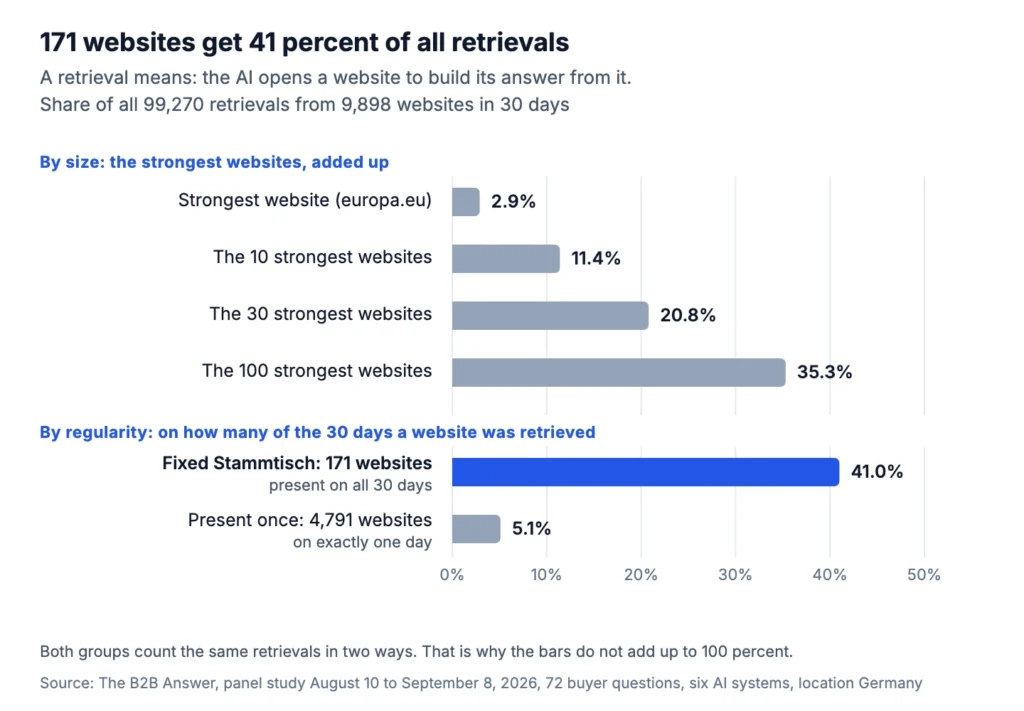
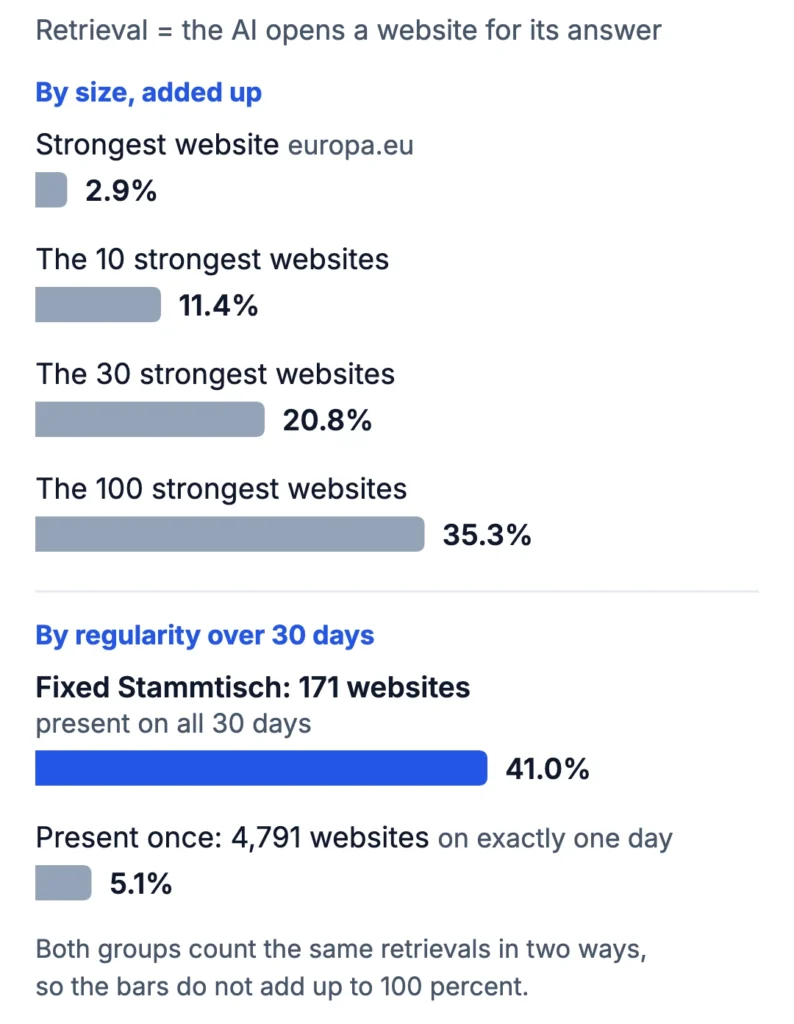
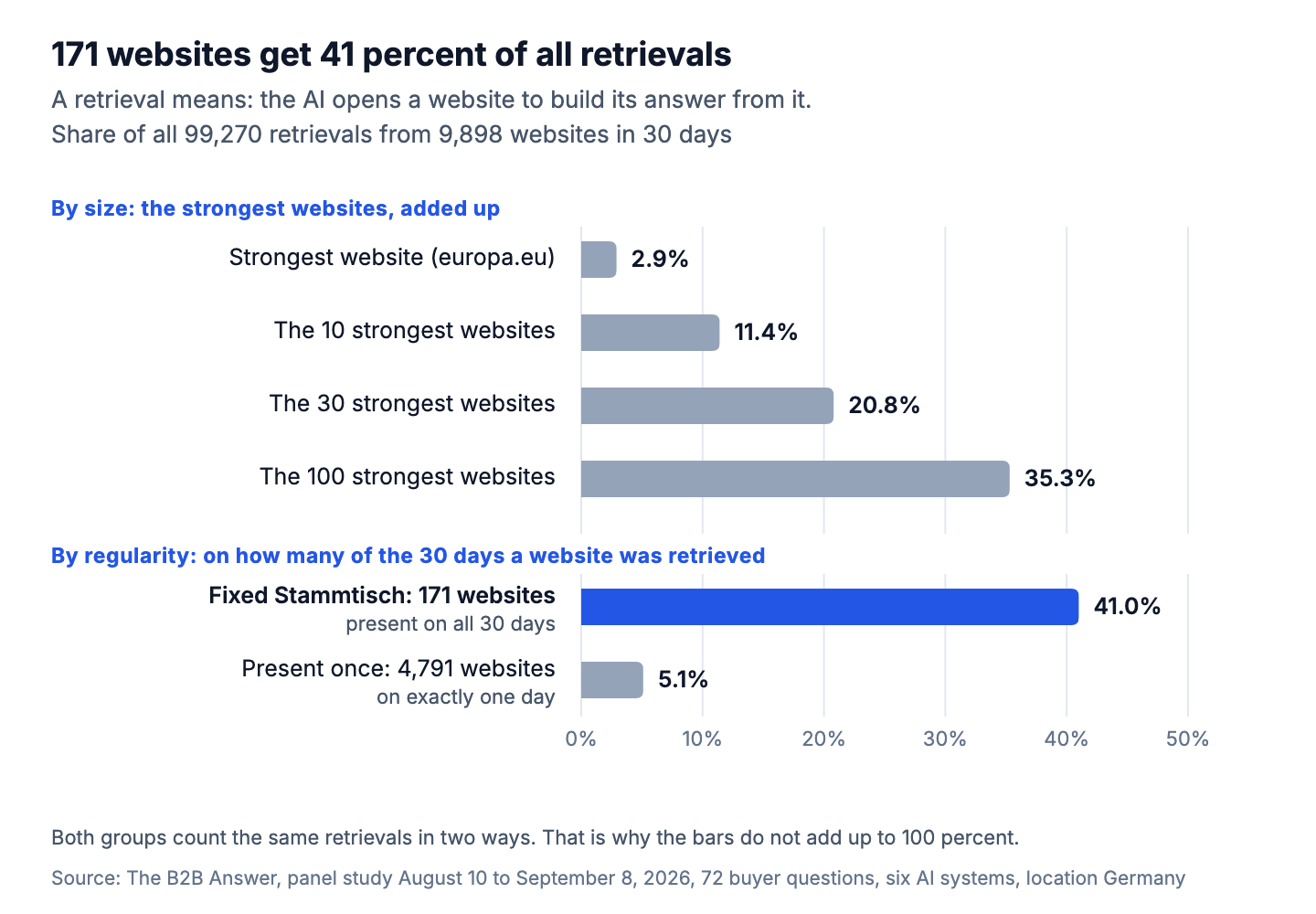
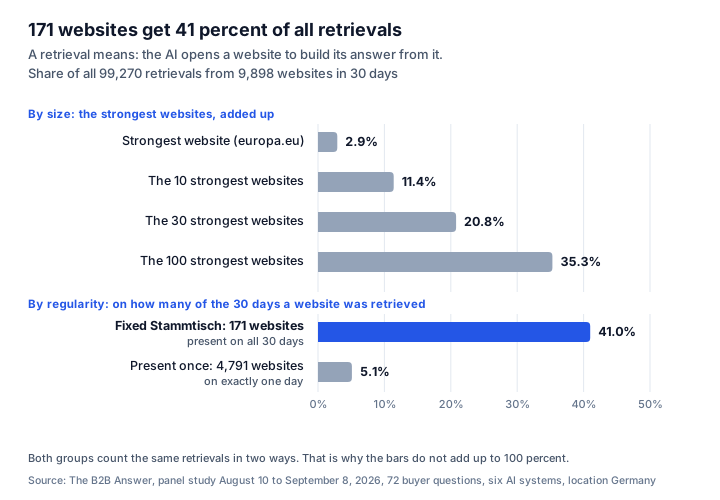
Industrial questions work differently. The most retrieved website in our panel is europa.eu, at three percent. The ten strongest websites together reach 11.4 percent, the thirty strongest 20.8 percent. Four out of five retrievals go to websites outside the top 30.
41%
of all retrievals go to a fixed Stammtisch of 171 websites that were present on every one of the 30 days.
The ten websites AI retrieved most often in the panel, with their share of all 99,270 retrievals.
| Rank | Website | Share of retrievals | What it is |
|---|---|---|---|
| 1 | europa.eu | 2.9% | EU law, regulations |
| 2 | wlw.de | 1.6% | Supplier directory |
| 3 | iso.org | 1.2% | Standards |
| 4 | youtube.com | 1.1% | Video |
| 5 | tacto.ai | 1.0% | Procurement glossary of a software vendor |
| 6 | elektroniknet.de | 0.8% | Trade publication |
| 7 | vdi.de | 0.7% | Association |
| 8 | ihk.de | 0.7% | Chamber of commerce |
| 9 | wikipedia.org | 0.7% | Reference work |
| 10 | dinmedia.de | 0.7% | Standards |
Fourteen of the thirty strongest websites are institutions: standards bodies, associations, public authorities and research institutes. Each retrieved address is counted here. ChatGPT often loads several subpages of a standards site within one answer. Counted per answer, it is five of thirty (recalculated on October 20, 2026). The top 10 contain no machine builder at all. The sources also change with the buying phase. Supplier directories such as wlw take ten percent of all retrievals in the solution comparison phase and less than two percent in the other three phases. Institutions take a fifth during internal validation and around five percent otherwise. Someone asking “who qualifies?” gets the directory. Someone asking “what applies?” gets the standard. A wlw listing pays off in exactly one phase, where it makes a noticeable difference. Even so, 90 percent of all retrievals from company websites go to actual manufacturers and service providers. The market is open, and it is broad.
This finding applies to Germany. In the same week, Semrush analyzed 458 industrial search terms in the US. There, AI mainly cites distributors, marketplaces and directories such as Grainger, ThomasNet or Vevor, and Semrush recommends partnerships with these sites. The manufacturers themselves barely appear there. Germany has no Grainger. Here, your own website plays the role the marketplace plays in the US, which makes it the most important seat you can take at the AI's Stammtisch.
Because retrievals are spread across many websites, there is no single switch to flip either. Behind the open top of the list, the AI still keeps a fixed Stammtisch: 171 websites, 1.7 percent of 9,898, were present on every one of the 30 days. This Stammtisch receives 41 percent of all retrievals, or 33 percent when counted per answer. The 1,011 websites present on at least 14 of the 30 days receive 73 percent. Almost half of all websites, 4,791, appear on exactly one day and share five percent.

Numbers as a table
| Group of websites | Share of all retrievals |
|---|---|
| Strongest website (europa.eu) | 2.9% |
| The 10 strongest websites | 11.4% |
| The 30 strongest websites | 20.8% |
| The 100 strongest websites | 35.3% |
| Fixed Stammtisch: 171 websites, present on all 30 days | 41.0% |
| Present once: 4,791 websites, on exactly one day | 5.1% |
What pays off
Secure a seat at your industry's Stammtisch, among the few dozen websites AI retrieves there every day. You get there with many pages that answer buyer questions (section 5). Websites at the table are retrieved every day, all others only occasionally.
3. AI searches the web most when your customer has to justify the purchase internally
Our 72 questions are spread across four phases of an industrial purchase (in German): orientation (“How do I describe my project for a first inquiry?”), solution comparison (“Custom machine or series machine?”), decision (“What down payment is usual?”) and internal validation (“Which documentation does the supplier have to provide so that our quality management approves?”).
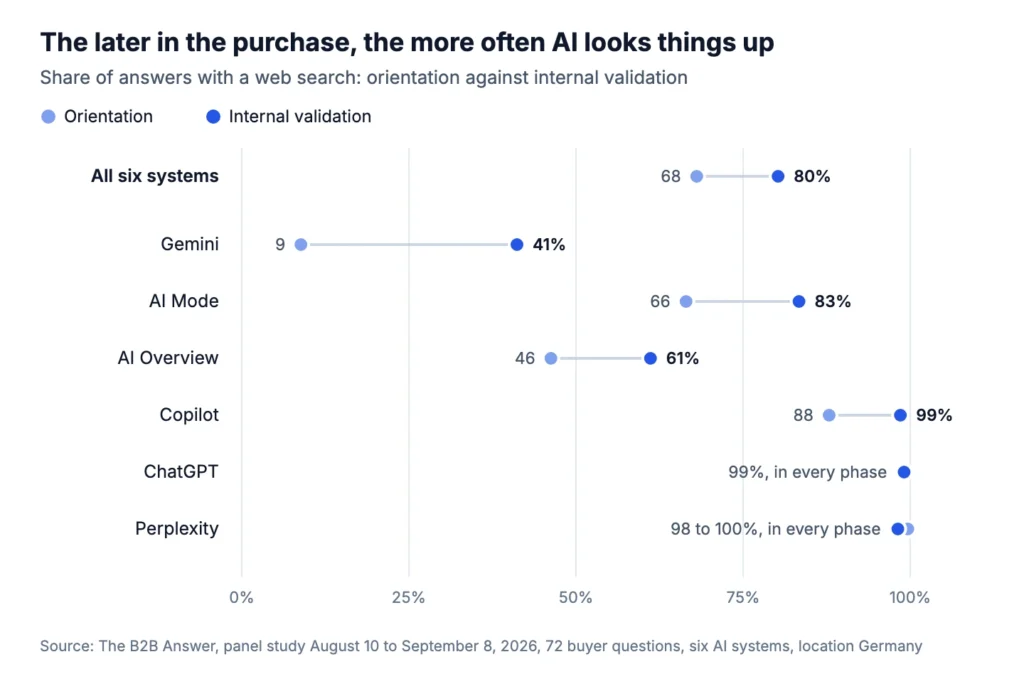
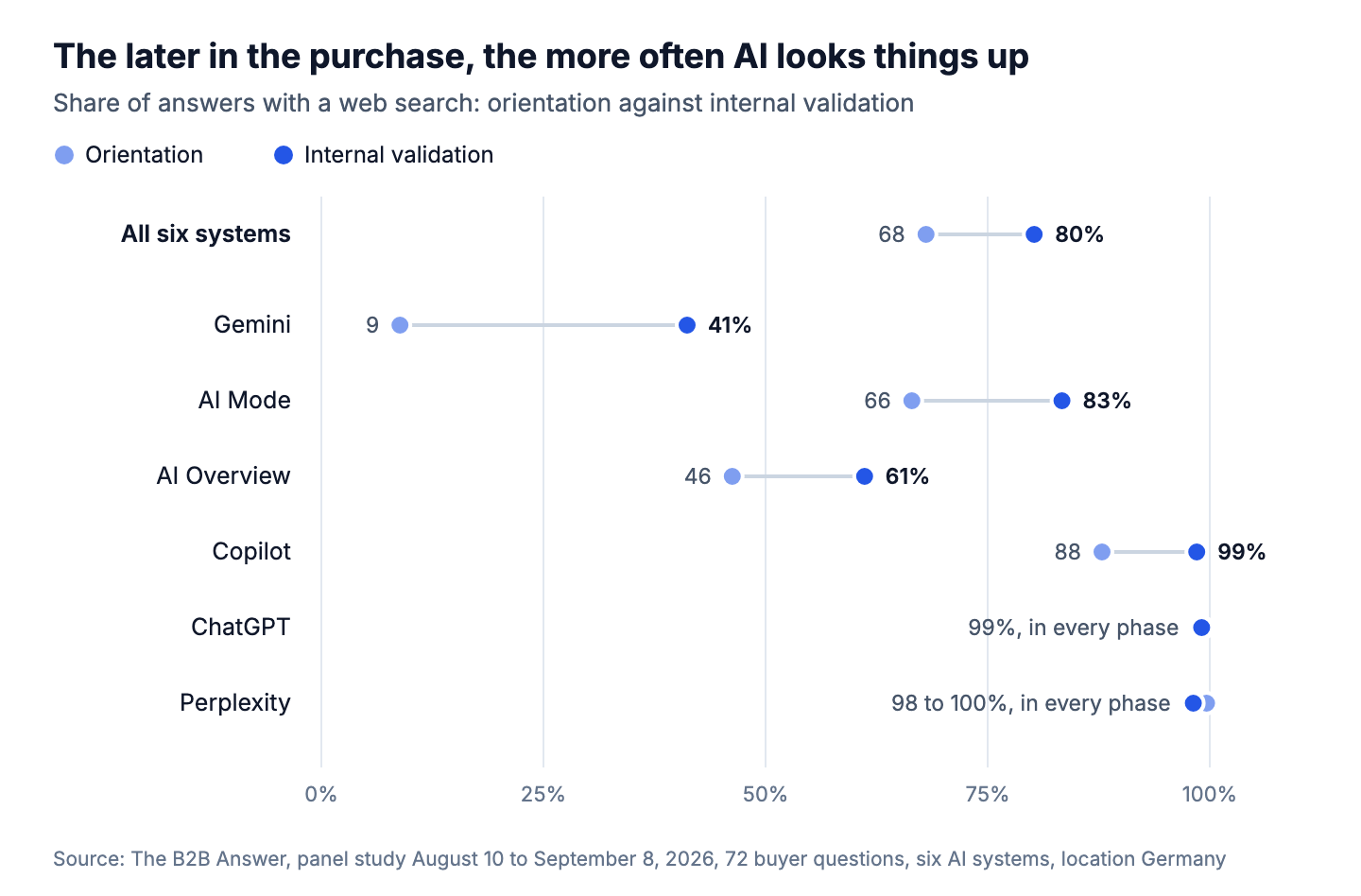
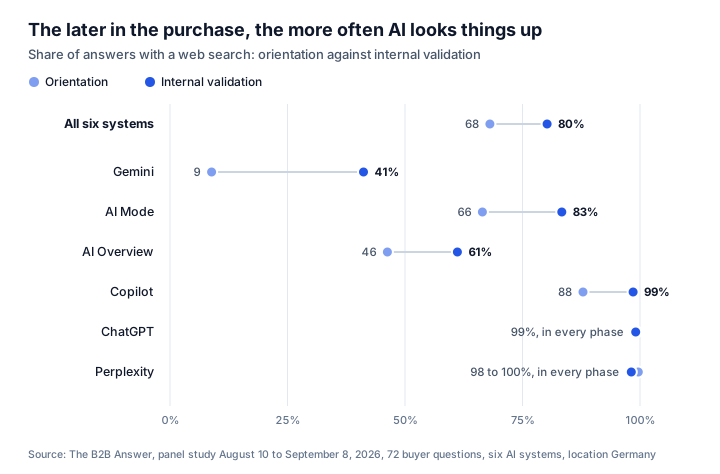
The last phase is the one in which your contact has to defend the decision inside their own company: to purchasing, to leadership, to quality management. We had expected AI to show web sources least often in this phase, because the questions sound more general. In fact, it shows them most often there, in 80 percent of answers.
80%
of answers show web sources when your customer has to justify the purchase internally.
| Buying phase | Share of answers with web sources |
|---|---|
| Orientation | 68% |
| Solution comparison | 73% |
| Decision | 75% |
| Internal validation | 80% |
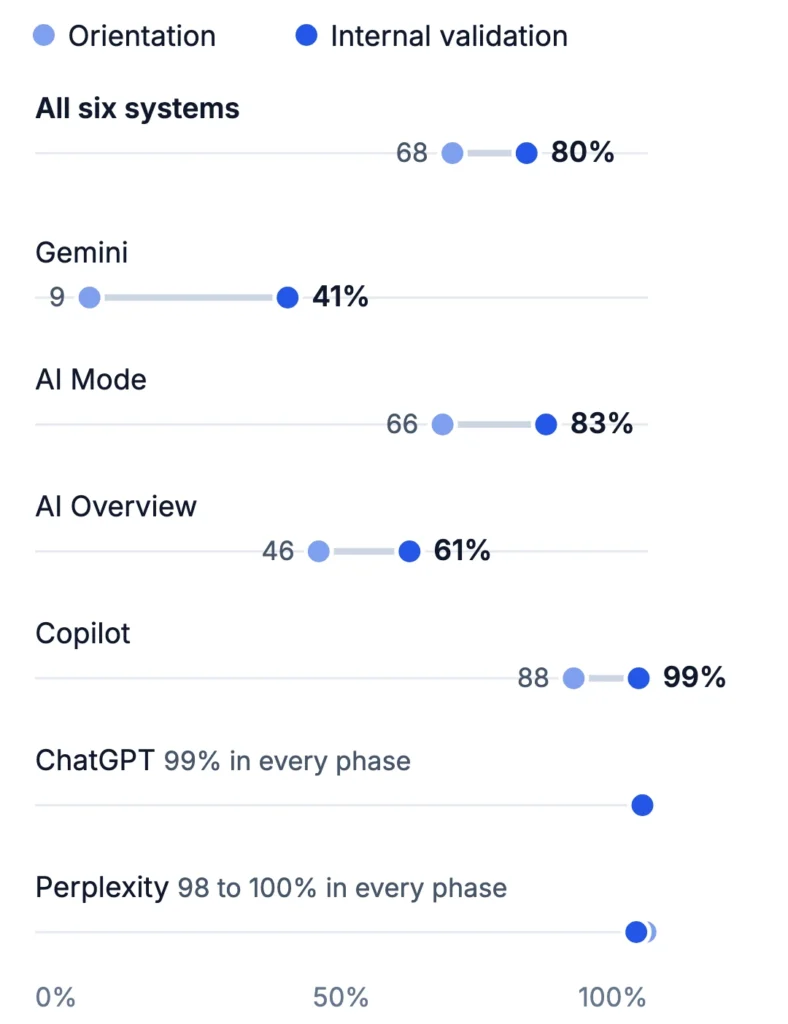
The increase holds steadily across all 30 days, before and after Google's redesign, and it passes the statistical test (validation against orientation t = 3.5, with the question as the unit of analysis, corrected for multiple testing). One caveat applies. ChatGPT and Perplexity show sources for practically every question, at 99 and 100 percent. The increase comes from the four systems that have room to vary: Google AI Overview rises from 46 to 61 percent, AI Mode from 66 to 83, Copilot from 88 to 99 and Gemini from 9 to 41. The two Google values mix the periods before and after the redesign of August 24 (section 6). Before the redesign, AI Overview and AI Mode show no difference between the phases, while Gemini does (recalculated on October 20, 2026).
The reason lies in the type of question. Validation questions are questions of fact: which standard applies, which deadline, which certificate. A language model cannot answer these reliably from memory, so it has to look them up. SISTRIX measured in September that Google's AI overview appears for 70 percent of informational searches and practically never for transactional searches. The validation question comes late in the buying process, and it is still an informational question. AI therefore helps with the checks before the purchase.
The form of the question matters as well as the phase. The five panel questions that begin with “How do I describe”, “How do I justify” or “How do I calculate” trigger a web search in 55 percent of answers on average, the other 67 questions in 76 percent. At the bottom is “How do I describe my automation project so that a special-purpose machine builder can quote it?” at 43 percent. At the top is “How do I comply with the new EU Machinery Regulation?” at 96 percent. A model can give instructions from its own knowledge. Standards and deadlines it has to look up. For your website, this means that a page explaining a standard, a deadline or a piece of documentation gets searched for. A page explaining how to describe a project competes with the model itself.
What pays off
The questions your sales team hears shortly before a contract is awarded are answered on very few websites so far: inspection certificates under EN 10204, reporting obligations under the EU Cyber Resilience Act, usual down payment levels, long-term availability of components, what a quality audit wants to see at a supplier. That is your least expensive opportunity. One such page costs an afternoon with your head of sales and an editor, and AI reads it exactly when your customer decides.
This matches what we hear from industrial clients. First contact usually comes through referrals and trade fairs. The website is the check that follows, and that check is the validation phase. This is where AI now shows web sources as well.
Whether buyers prepare their trade fair visit list with AI is outside what we measured. We did measure what AI reads when someone asks who qualifies: in the solution comparison phase, mainly supplier directories such as wlw and the company websites themselves (section 2). A company missing there is also missing from a visit list built this way.
More on this phase, with the pages read most often in it: AI searches most often when your customer has to validate internally (in German).
Numbers as a table
| AI system | Orientation | Internal validation |
|---|---|---|
| All six systems | 68% | 80% |
| Gemini | 9% | 41% |
| Google AI Mode | 66% | 83% |
| Google AI Overview | 46% | 61% |
| Copilot | 88% | 99% |
| ChatGPT | 99% | 99% |
| Perplexity | 100% | 98% |
4. Two hurdles: your page decides whether AI reads it, the AI system decides whether it cites it
This finding explains why many GEO measures achieve less than hoped. GEO, generative engine optimization, is the name for optimizing content for AI answers.
On its way into an AI answer, a website clears two hurdles. First, the AI retrieves it: the page joins the set of candidates the answer is built from. Second, the AI cites it, as evidence in the text, with a link. In this study, “retrieval” means the AI loaded the page for an answer, and “citation” means the page appears in the answer as a source. We examined both hurdles separately, and they follow completely different rules.
Hurdle 1, being considered: your page decides. We compared 198 pages that AI never retrieved in 30 days with 78 retrieved pages from the same 68 company websites. The retrieved pages are visibly built differently. They are marked up as articles (64 against 36 percent), name an author (63 against 39 percent), are longer, more structured and contain more lists. Above all, they cover costs and prices (42 against 10 percent) and end with a conclusion (38 against 10 percent). In this sample, guide and knowledge pages make up 51 percent of the retrieved pages, product pages four percent.
Hurdle 2, being cited: the system matters most. We downloaded and measured 101 retrieved manufacturer pages ourselves: 50 that are cited almost every time against 51 that are almost never cited. The two groups are alike in all 21 features we checked, including length, headings, tables, FAQ schema, author and date. The smallest difference had a p-value of 0.107. The comparison is small, though: it would only have reliably detected differences of about 26 percentage points or more. A recalculation across 4,183 answers shows opposite associations per system. Google tends to cite pages with tables more often, ChatGPT less often. An effect of FAQ schema or tables is therefore neither shown nor ruled out (recalculated on October 20, 2026).
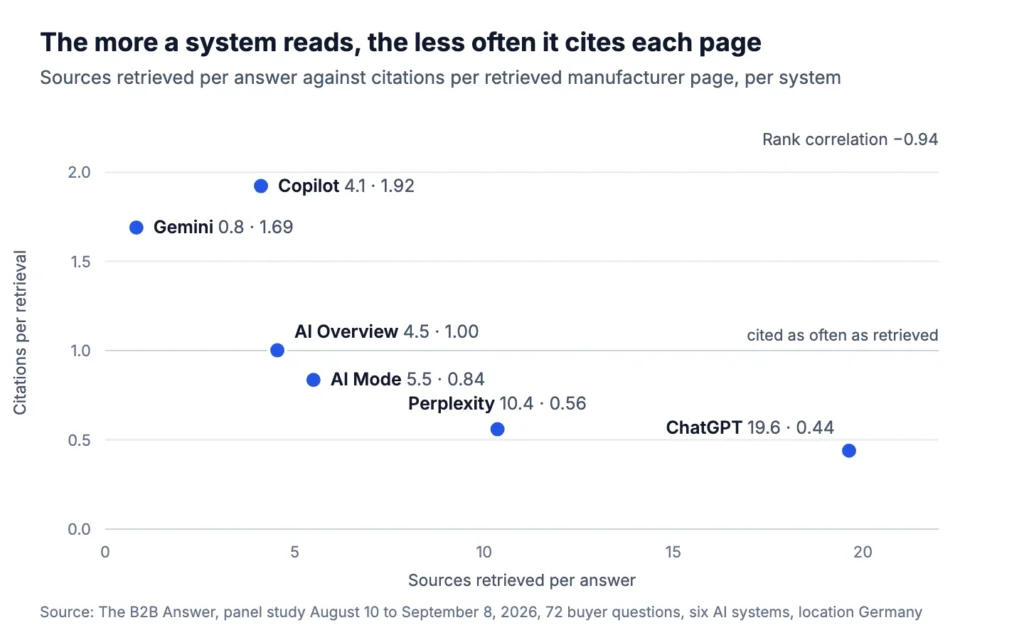
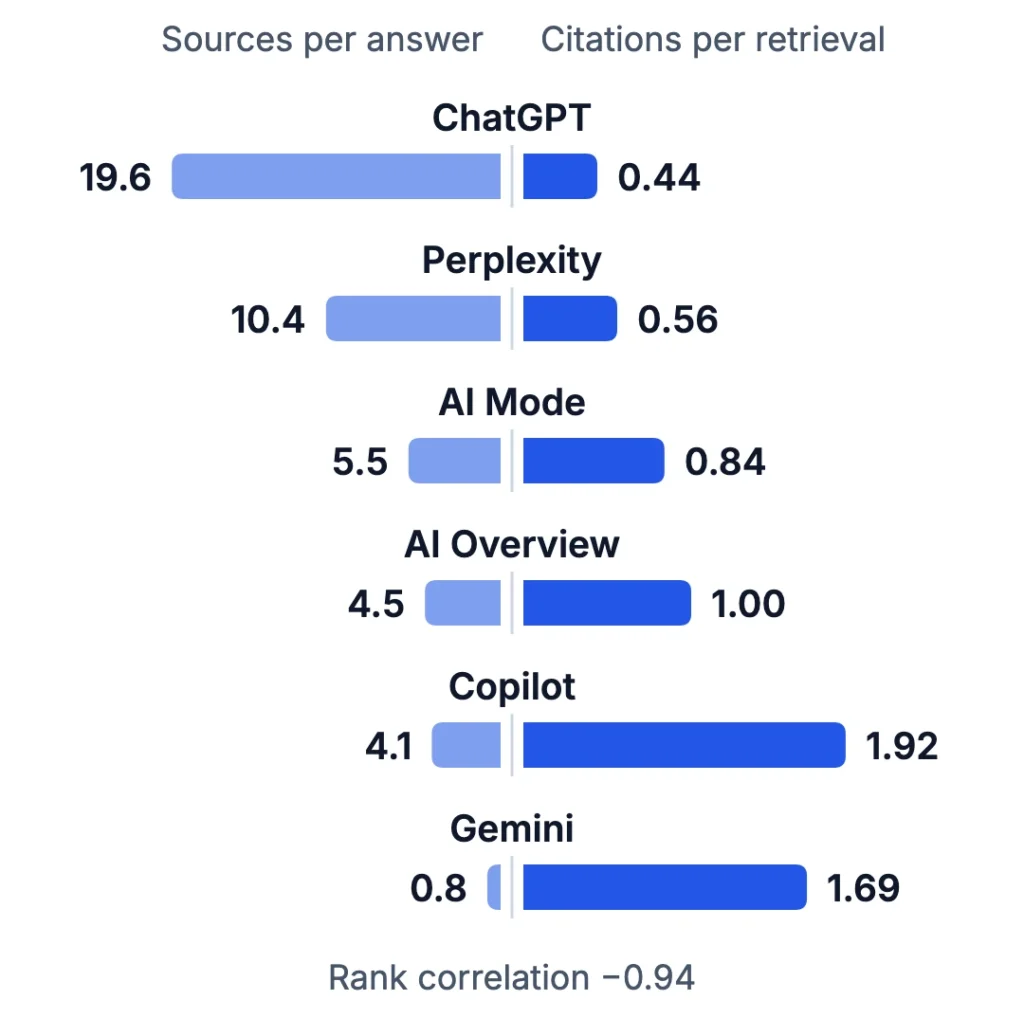
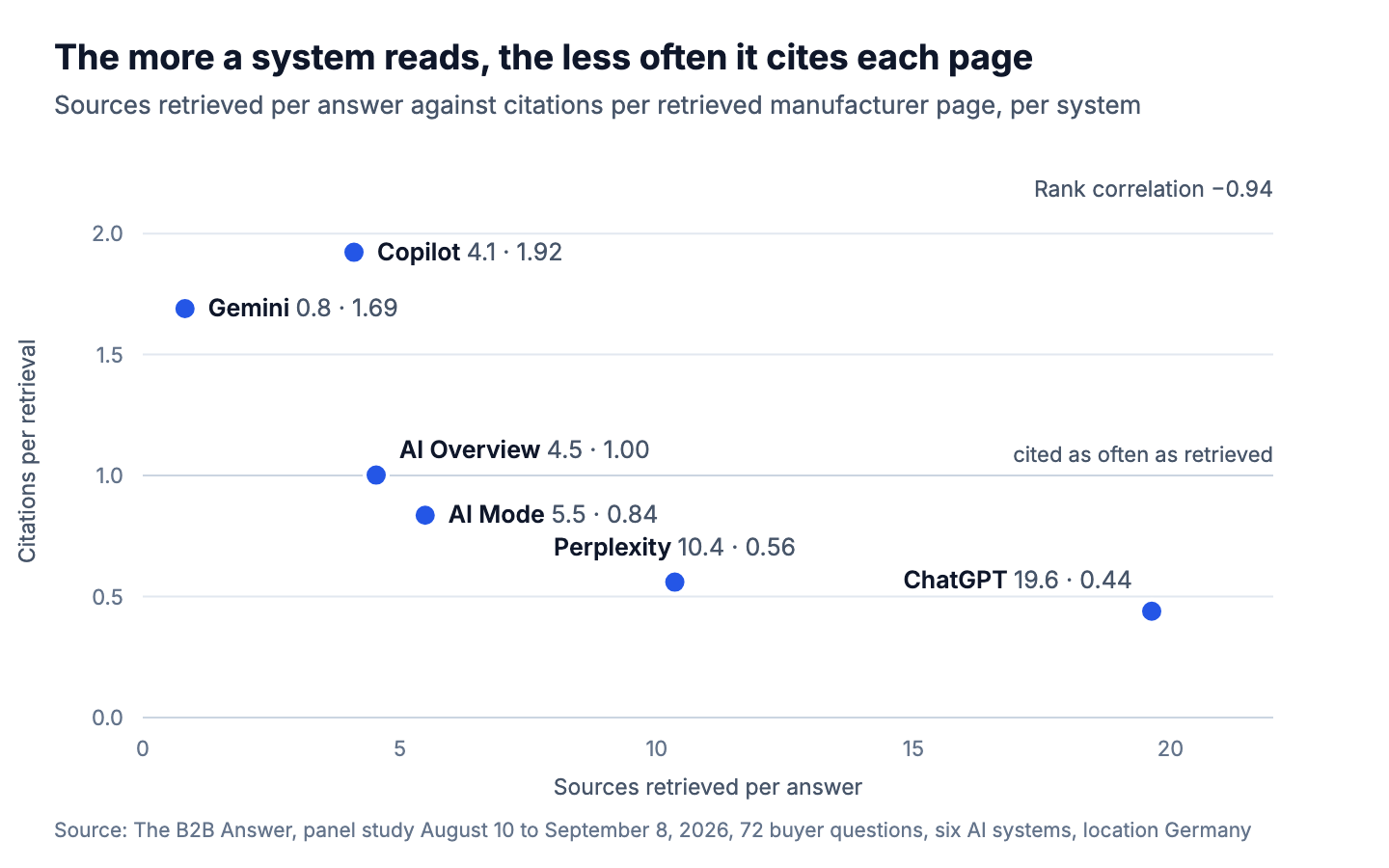
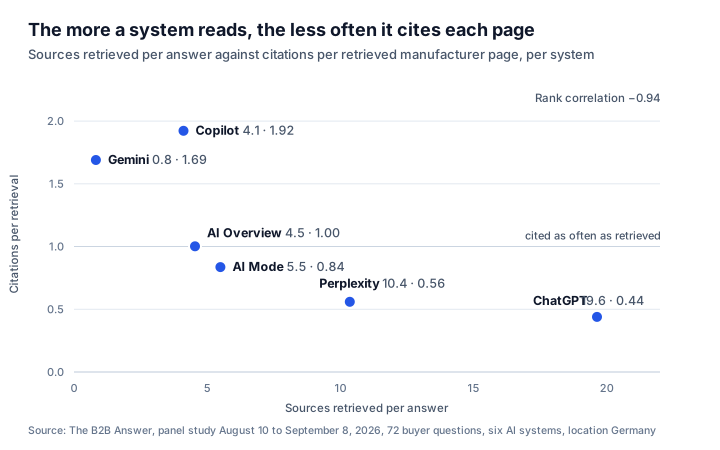
Whether a page is cited depends mainly on the AI system that answers. The table shows two values per system: on the left, how many sources it reads for one answer; on the right, how often it then cites a retrieved manufacturer page. A value above 1 means the system cites a retrieved page more than once on average. The pattern: systems that read a lot cite the individual page rarely.
Numbers as a table
| System | Sources retrieved per answer | Citations per retrieved manufacturer page |
|---|---|---|
| ChatGPT | 19.6 | 0.44 |
| Perplexity | 10.4 | 0.56 |
| AI Mode | 5.5 | 0.84 |
| AI Overview | 4.5 | 1.00 |
| Copilot | 4.1 | 1.92 |
| Gemini | 0.8 | 1.69 |
4 in 10
retrieved pages are also cited by ChatGPT. Copilot cites each retrieved page almost twice on average. Whether your page gets cited therefore depends mainly on which AI system answers.
The more sources a system retrieves, the smaller the share it cites. ChatGPT reads around twenty sources per answer and cites four in ten. Copilot reads four and cites each of them almost twice on average. The relationship is almost perfect (rank correlation of minus 0.94). In citations per retrieved manufacturer page, the systems differ by a factor of up to 4.4 (ChatGPT 0.44, Copilot 1.92). Between the four buying phases, it is only a factor of 1.15.
What pays off
Invest in more pages that answer buyer questions. Every page that AI reads puts you in the set of candidates, and that part is decided by your page. Whether it is cited after that is up to the AI system. For money spent on technical work such as FAQ markup, comparison tables and schema markup, we found no detectable effect on citation.
The measurement in detail: FAQ schema and tables: what they change about AI citations (in German).
5. AI reads guide pages a lot and rarely reads product pages or case studies
Four patterns emerge from 14,580 manufacturer pages in the panel. The sections were assigned by address, for example /guide/. Just over half of the retrievals could not be assigned to a section. Guides lead under every way of counting (recalculated on October 20, 2026). They apply to hurdle 1, being retrieved.
29%
of retrievals on manufacturer pages go to guide and knowledge pages. Product pages get 8 percent.
Guide pages get 3.6 times as many retrievals as product pages, and 1.5 times as many per page.
How retrievals on manufacturer pages split across the sections of a website. The right column shows how often a retrieval then also leads to a citation.
| Section of the website | Share of retrievals | Citations per retrieval |
|---|---|---|
| Guides, knowledge, glossary | 29.3% | 0.94 |
| Products, services | 8.2% | 0.67 |
| Homepage | 4.8% | 0.58 |
| Company, about us | 2.4% | 0.62 |
| PDF documents | 1.9% | 0.96 |
| References, case studies | 0.6% | 0.49 |
References and case studies, often the most expensive item in a Mittelstand company's content budget, play almost no role in buyer questions to AI: 0.6 percent of retrievals and the lowest citation rate. This says nothing about their quality. They simply answer none of the questions a buyer asks before buying.
Individual articles in a guide section take the most retrievals. An address like company.com/guide/down-payment is typical: such guide articles take almost a third of all retrievals (29 percent), the homepage less than five percent.
The strongest pages answer a buyer question. The titles of the strongest manufacturer pages in the panel read (translated from German): “The most important certifications for industrial suppliers”, “Supplier certificate”, “Finding a special-purpose machine builder”, “Total Cost of Ownership”, “EMS costs explained transparently”, “How high should a down payment be?”, “Custom machine or series machine?”, “Selection criteria for EMS providers”, “Laser cutting tolerances”, “EN 10204”. None of these titles names a product feature. All ten are questions a buyer asks before looking for a product.
A cross-check shows how narrowly this applies. We examined seven industrial websites whose landing pages rank at the top of Google for product terms. These pages have question headings and around 900 words, built formally exactly the way hurdle 1 rewards. Six of these seven companies are absent from the panel. Their pages answer the question about the product. AI reads the pages that answer the question that comes before the product.
Many pages have more effect than one showcase page. 65 company websites reach at least 100 retrievals. On average, they collect them across 18 different pages. Only three of the 65 manage it with three pages or fewer. The exception proves the rule: a single 2023 blog post by an embedded systems manufacturer, “How do I find the right embedded systems supplier?”, was retrieved 113 times and cited 108 times, more than entire competitor websites. It answers one buyer question, sits two levels deep, has 1,020 words and has stayed unchanged for three years.
The most read and most cited manufacturer page in the entire panel is machine-generated text with a grammatically flawed title. It matches the topic, and that is enough for hurdle 1. It shows that topical fit alone can be enough to be read, even with weak language. What becomes of such pages in six to eighteen months is something we will check in the next round.
ChatGPT searches for numbers and standard numbers, rarely for company names. We recorded 5,970 search queries that ChatGPT and Perplexity send to search behind the scenes. ChatGPT never sends the user's question as it was asked. It builds keyword strings of nine words and adds what the question left out: a number in 43 percent of queries, usually a standard number (an ISO standard in 652 of 3,637 queries, ISO 9001 alone 368 times), “Deutschland” or “Germany” in every fourth query, the English word “official” 260 times, and in three percent of cases it restricts the search directly to iso.org or EUR-Lex. It almost never searches for an evaluative adjective (2 of 3,637 queries) and searches for a number almost every second time. It almost never searches for your company name: a manufacturer name appears in 1.8 percent of queries. For your compliance pages, this means writing out the standard number, writing out the location and linking the primary source. All figures on the search queries: What ChatGPT really searches for (in German).
Which page to build for which buying phase, and what it costs: Which page type for which buying phase? (in German).
6. Since August 24, Google shows its sources only on click
Google redesigned its AI answers in the middle of the measurement period. This section therefore shows two states: before and after August 24.
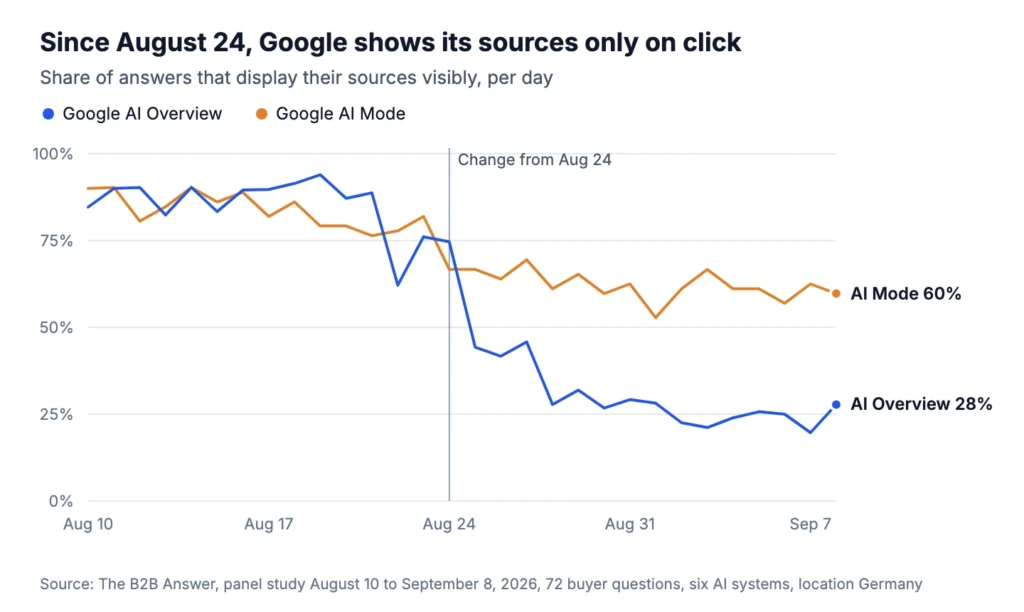
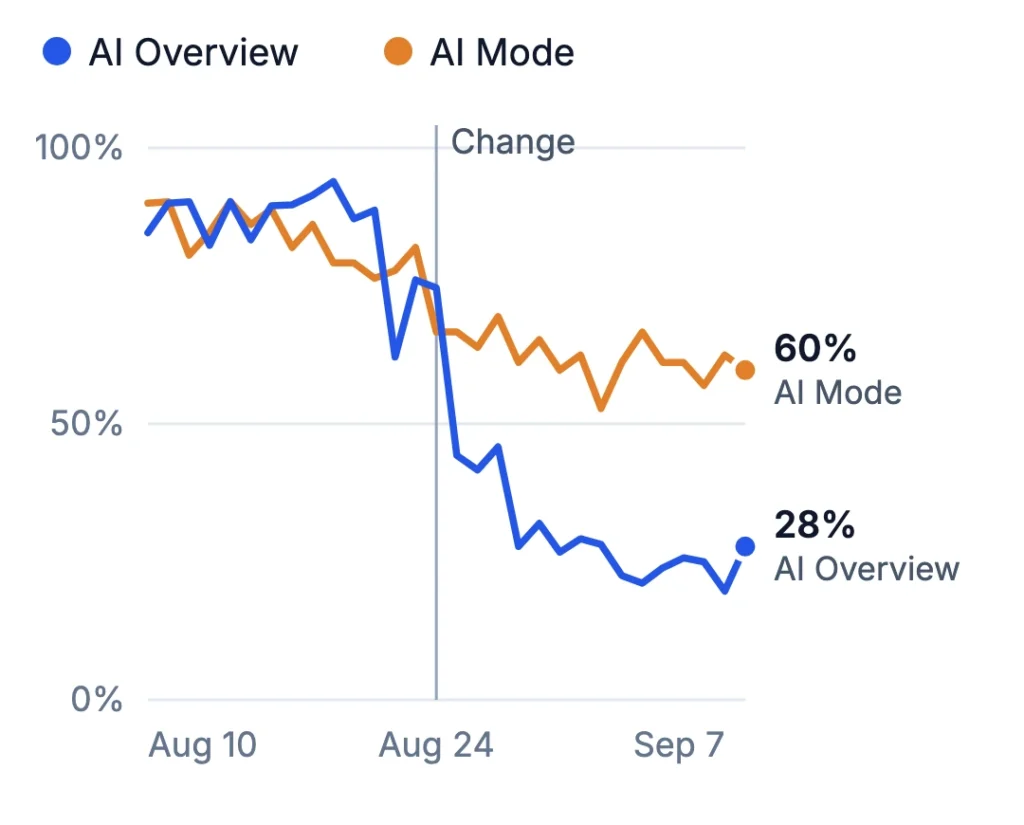
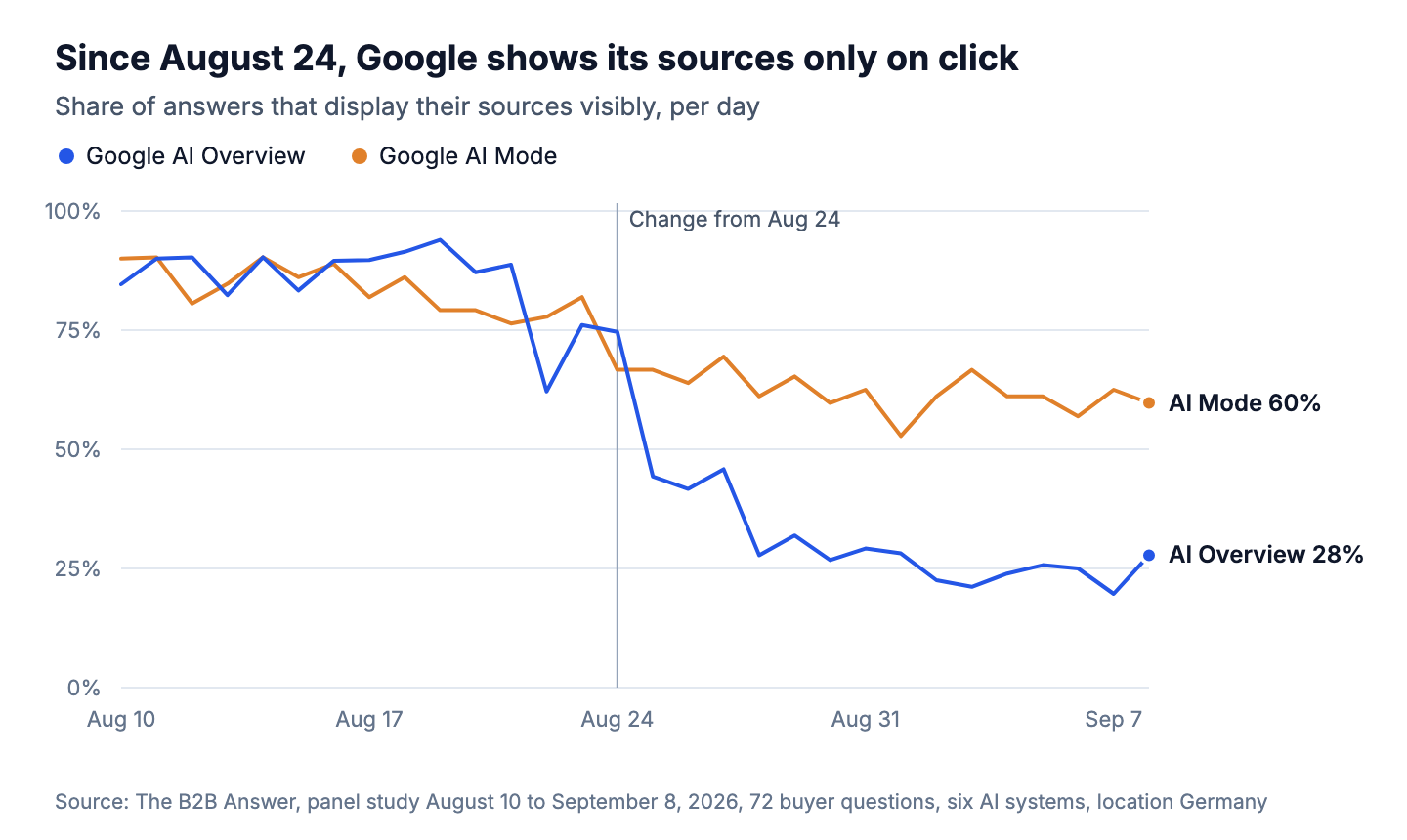
Up to August 23, Google's “AI Overview” showed its sources directly in 86 percent of answers: small cards with the company name and a link, as you know them. From August 25, this value fell by two and a half percentage points every day, and since September 2 it has been at 24 percent. The overview itself has stayed and has even become longer. What is missing are the cards.
To rule out a measurement error, we cross-checked the value twice. DataForSEO reads Google with a different technique and came to the same result on the same sample. On September 9, we also checked ourselves in Chrome, with the location set to Germany and without being logged in. This showed that Google now delivers the overview in two versions. In the old version, the sources appear as links in the answer. In the new version, which now appears for three out of four questions, a small link icon sits at the end of each paragraph. Only someone who clicks it sees where the paragraph comes from.
What this means for you:
- Google's AI answers still use your website, and show it less often. The sources are still there, one click further away, and very few people click.
- Any visibility curve that runs across August 24 compares apples with oranges. If an analysis shows a drop in your Google AI visibility in September, the first question is how it was measured.
- ChatGPT, Copilot and Perplexity still show their sources as before.
This tells us nothing about whether Google looks things up less often. Whether the model behind the overview keeps reading websites cannot be measured from outside. Only what is displayed can be measured.
1 in 4
answers still shows Google’s sources visibly since August 24. Before that, it was six out of seven.
Numbers as a table
| Day (2026) | Google AI Overview | Google AI Mode |
|---|---|---|
| Aug 10 | 85% | 90% |
| Aug 11 | 90% | 90% |
| Aug 12 | 90% | 81% |
| Aug 13 | 82% | 85% |
| Aug 14 | 90% | 90% |
| Aug 15 | 83% | 86% |
| Aug 16 | 90% | 89% |
| Aug 17 | 90% | 82% |
| Aug 18 | 91% | 86% |
| Aug 19 | 94% | 79% |
| Aug 20 | 87% | 79% |
| Aug 21 | 89% | 76% |
| Aug 22 | 62% | 78% |
| Aug 23 | 76% | 82% |
| Aug 24 | 75% | 67% |
| Aug 25 | 44% | 67% |
| Aug 26 | 42% | 64% |
| Aug 27 | 46% | 69% |
| Aug 28 | 28% | 61% |
| Aug 29 | 32% | 65% |
| Aug 30 | 27% | 60% |
| Aug 31 | 29% | 62% |
| Sep 1 | 28% | 53% |
| Sep 2 | 23% | 61% |
| Sep 3 | 21% | 67% |
| Sep 4 | 24% | 61% |
| Sep 5 | 26% | 61% |
| Sep 6 | 25% | 57% |
| Sep 7 | 20% | 62% |
| Sep 8 | 28% | 60% |
7. Industry, technical vocabulary and page structure matter less than expected
Industries differ less than we thought. We had expected machine building sectors with dense directories to get different source types than electronics sectors. The differences within the industry groups are larger than those between them. There are patterns, and they run across our assumption.
With or without technical vocabulary in the question, the source types stay the same. The difference was just significant in one time window and disappeared after correcting for multiple testing.
AI Mode and AI Overview differ less than we first wrote. An early analysis found that AI Mode and AI Overview share only a fifth of their sources. The complete measurement shows that AI Mode shares just as little with itself on the previous day. We cannot separate the difference between the surfaces from the daily fluctuation. SISTRIX can, with 82,619 questions over 17 weeks, and finds it. We report this as a SISTRIX finding and withdraw our earlier statement.
For FAQ markup and tables, we found no effect on citation. See section 4. This expectation weighs the most, because many budgets rest on it.
There is also a limit that applies to every measurement of AI answers.
Single queries fluctuate strongly. Every answer is assembled anew, like a throw of the dice at the Stammtisch. If you ask ChatGPT the same question today and tomorrow, the two answers share only a sixth of their sources. Google AI Mode behaves the same way. Between different systems, the overlap is close to zero. Only Perplexity, which passes your question on to search word for word, returns the same sources on quiet days, three quarters on average over 30 days. For all others, a single query is a single throw of the dice (in German). A trend from five queries is therefore mostly chance. Only many throws show on how many sides of the die your name appears.

This also affects our own statistics. The effective sample of this study is 72 questions, while the 13,108 answers are repeated measurements of them. Treating the answers as independent produces confidence intervals that are three times too narrow. All intervals here are calculated at the level of the question.
8. What morefire, Radyant and Semrush measured, and what this study adds
Three studies measured before us how AI systems choose suppliers, each from a different angle.
morefire (summer 2026) asked whether AI cites a brand’s own website when someone asks about its product category, across 62 categories of German industry. The result: a company’s own website is cited in only around five percent of cases, and almost half of the brands (46 percent) are missing entirely from at least one of five runs.
Radyant (June 2026) worked with OMR Reviews to find out where AI gets its answers about software. The result: review platforms dominate there, and a single one supplies 13.5 percent of retrievals. A second Radyant study asks from the perspective of different buyer types.
Semrush (September 8, 2026) analyzed 458 industrial search terms in the US. A Google AI overview now appears for over 57 percent of search volume, up from 38 percent in January. Yet only 0.48 percent of visits to industrial websites come from AI systems. This matches our picture: AI answers appear more and more often, and they lead to hardly any clicks to the website. Buyers who get in touch afterwards call directly or show up in your analytics as “direct” traffic.
What this study adds: which websites AI reads for industrial questions (so far this existed only for software, with the opposite result); what changed with Google’s redesign on August 24; what AI looks for when your customer has to justify the purchase internally; why being read and being cited are two different things; and how much answers fluctuate from day to day. This becomes visible because we measured daily for 30 days. The raw data for every page is available for download.
The percentages of the three studies cannot be compared directly: morefire’s five percent refers to citations within a company’s own category, Radyant’s 13.5 percent to all retrievals across all questions.
9. Methodology in brief
Panel: 72 questions from six industries (special-purpose machine building, automation and robotics, manufacturing technology, measurement technology and sensors, embedded hardware, electronics manufacturing), twelve questions each, spread across four buying phases. The questions are brand-neutral and come from real first sales conversations and sales questions.
Systems: ChatGPT, Google AI Overview, Google AI Mode, Gemini, Microsoft Copilot, Perplexity. All were measured through the user interface, without an API. Location Germany, language German.
Period: August 10 to September 8, 2026, daily, 30 days. 13,108 answers, 99,270 retrieved sources, 9,898 websites. By calculation it would be 12,960 answers (72 questions × 6 systems × 30 days): on the first day some questions ran more than once, and on some days answers are missing, mostly for AI Overview. The daily series in the data package shows both. All numbers in the text cover the full 30 days, with time windows only where Google's redesign requires them.
Measurement: Peec AI as the panel platform. DataForSEO as a second instrument for the Google surfaces. A cross-check in the browser on September 9. Our own downloads and measurements of 101 retrieved pages and 198 pages that were never retrieved.
Statistics: The question is the unit of analysis. Confidence intervals are calculated at that level. Correction for multiple testing (Benjamini-Hochberg), with corrected and uncorrected values reported. We calculated citation rates ourselves, independently of the platform's own metric.
Limits: Six industrial sectors; regulated industries and software are outside the panel. 72 questions. One country, one language. That is more than a footnote: according to Żatuchin (Rankfor.AI, June 2026, 35,640 answers in twelve European languages), asking in the local language lifts local providers far more than large corporations. Our numbers apply to German questions, and they cannot be transferred to English questions. The page types were classified by the platform; a recalculation with our own classes will follow in the next round. The language of the cited pages was outside the measurement. A follow-up measurement in October 2026 (ChatGPT, 34 searches for ten buyer questions) found that ChatGPT searches German questions mostly with German words (79 percent). Google's redesign was measured over time with one instrument, and the level after it with two instruments plus the browser. Claude was outside the panel.
Conflict of interest: The B2B Answer advises industrial companies on visibility in AI systems. The study measures what we sell. That is why we set the hypotheses before measuring, publish the raw data, include a section on what did not happen, and recommend putting less budget into a widespread consulting package.
Data: The question set, all retrieved websites and pages, daily series per system and the search queries of ChatGPT and Perplexity as CSV, free to use with attribution. Go to the download.
Next round: In the first quarter of 2027 we will measure again with the same 72 questions, this time including Claude. If the measuring instrument changes, we will flag it for every figure. Every number in this text then becomes a time series.
Versions: Published on September 13, 2026. Recalculated and refined on October 20, 2026: counting method and test power added, labels sharpened, individual figures corrected. The core findings are unchanged.
What to do before your next trade fair
Raw data and download
Free to use with attribution. You can recalculate every number from the raw data. Both files are in German, and so is the Markdown version for AI systems.
What the data package contains
The study as a PDF, six CSV files with semicolons and decimal commas, all four charts as PNG and SVG, and a description of the fields. The column names and the field description are in German.
- fragenset.csv: the 72 questions with industry, buying phase and question type
- websites.csv: all 9,898 retrieved websites with retrievals, citations and days in the panel
- seiten.csv: all 27,311 retrieved pages with title, retrievals and citations
- tagesreihe-quellenanzeige.csv: share of answers with a web search per day and system
- suchanfragen-chatgpt-perplexity.csv: the 5,970 search queries behind the answers
- systeme.csv: the key figures per system
How to cite this study: Bock, Oliver (2026): Which websites does ChatGPT read when your customer looks for a supplier? What 13,108 AI answers show. Panel study on AI sources, August 10 to September 8, 2026. The B2B Answer, Munich. English version of “Welche Websites liest ChatGPT, wenn Ihr Kunde einen Anbieter sucht?”. https://theb2banswer.de/en/studies/ai-sources-german-industry-2026/
Short form for posts and slides: The B2B Answer, panel study on AI sources in German industry and Mittelstand 2026, theb2banswer.de/en/studies/ai-sources-german-industry-2026/
What leadership and marketing teams ask about the study.
Does this apply to my industry?
The panel covers six industrial sectors: special-purpose machine building, automation and robotics, manufacturing technology, measurement technology and sensors, embedded hardware, and electronics manufacturing. The differences within these groups are larger than those between them, so the findings apply to industry and the Mittelstand as a whole. Software and e-commerce follow other rules, with dominant platforms. All questions were asked in German from Germany, so the findings describe what German-speaking buyers in Germany see.
Google still has 90 percent of search. Why should AI search matter to me?
Because Google itself has become an AI search engine. For industrial search terms, an AI overview now appears for more than half of the search volume, up from 38 percent in January (Semrush, September 2026, 458 terms, US). For informational queries, it appears in 70 percent of cases according to SISTRIX. This overview is an AI answer built from websites, and since August 24 Google shows its sources only on click (section 6). The real question is which websites supply the answer your customer reads, on Google and on ChatGPT alike.
How robust are 72 questions?
The 72 questions are the sample, and the 13,108 answers are the measurements of them. Every question ran daily for 30 days in six systems, so the averages are stable. All confidence intervals are calculated at the level of the question, and section 7 lists the expectations the data did not confirm.
Why is Claude missing, and does it matter?
Yes, it matters, and it is a gap in this study. Our measurement platform did not cover Claude during the measurement period. Claude is growing fast: according to Similarweb, Claude had 9.6 percent of visits among the major AI chatbots in August 2026, up from about 2 percent a year earlier, while ChatGPT's share fell from 78 to 57 percent. Anthropic explicitly positions Claude for work inside companies, and industrial clients already tell us about inquiries that came through Claude. There is also a technical difference: according to Anthropic's own list of service providers, Claude runs its web search through Brave Search. The sources in this study therefore cannot be transferred one to one to Claude. Claude will be in the panel in the next round. Until then, a quick test is worthwhile: search for your most important guide pages on search.brave.com. Whatever is missing there is much harder for Claude to find.
May I use the data and charts?
Yes, freely, with attribution. The data package contains all CSV files, the four charts as PNG and SVG, and the study as a PDF, all in German. The English charts on this page can be downloaded below each chart. The citation suggestion is just above the download.
What is the first step for an industrial company?
Ask your sales team for the last five questions customers asked shortly before awarding a contract. Each of these questions becomes a page with the standard number, the location and a link to the primary source. Each page costs an afternoon of expert input and one day of editing.
Will the study be repeated?
Yes, in the first quarter of 2027, with the same 72 questions, this time including Claude. Every number then becomes a time series, and we will see whether Google's change of August 24 lasts.
Sources and contextclick to expand
- morefire with ucited: GEO study on the AI visibility of B2B brands, July 14, 2026. 62 categories in German industrial B2B, ten brand-neutral questions each, four AI systems, five runs, 12,250 answers. Measures the brand side: which manufacturers are cited. View study (in German)
- Radyant and OMR Reviews: Software Prompt Study, June 2026. 20,160 answers to buyer questions about software in eight categories. OMR Reviews receives 13.5 percent of all retrievals. View study
- Radyant: Persona Study, June 2026. 17,929 answers, eight roles, five AI systems, with correction for multiple testing. View study
- SISTRIX: AI SEO in e-commerce, September 1, 2026. The top fifth of shops receives around 72 percent of all AI citations. AI Overviews appear for 69.7 percent of informational and 0.2 percent of transactional searches. View article (in German)
- SISTRIX: AI Citation Drift, April 28, 2026, updated August 21, 2026. 82,619 prompts over 17 weeks in six countries. Google AI Overviews and AI Mode share 17 percent of their domains for the same prompt. View article (in German)
- Żatuchin, Dmitrij (Rankfor.AI, EUAS Tallinn): The Language Blind Spot, arXiv 2606.23165, June 22, 2026. 35,640 answers, twelve European languages, 66 brands, three AI systems. Asking in the local language lifts the recommendation share of local market leaders by 0.80 and that of large corporations by 0.15. Data and code openly available on Zenodo. The author runs his own provider business. View paper
- Semrush: AI Search and Manufacturing SEO, September 8, 2026. 458 industrial search terms in the US. AI overviews appear for 57 percent of search volume, and 0.48 percent of visits come from AI systems. View article
- Similarweb Investor Solutions: Anthropic IPO analysis, September 24, 2026. Share of visits among the major AI chatbots worldwide in August 2026: ChatGPT 57 percent (78 a year earlier), Claude 9.6 percent (about 2 a year earlier). The figures are worldwide and across all industries. View analysis
- Usage shares of AI searches, worldwide, cited second-hand: First Page Sage with Similarweb and Semrush, April 2026 (ChatGPT 60.7 percent, Gemini 21.5 percent, Copilot 13.2 percent, Perplexity 5.8 percent, Claude 4.1 percent of AI searches). View report (in German)
Our own measurement: panel on Peec AI, 72 questions, six AI systems, daily from August 10 to September 8, 2026, location Germany, language German. Google surfaces additionally checked with DataForSEO and in the browser on September 9. We read the third-party studies at their primary source and cite them only where they measure a different question from this study.